I often talk about how expensive it is to shoot film nowadays, and I keep receiving comments, especially from my Chinese audience. They say, ‘Sam, have you tried motion picture films? Sam, you should try motion picture films! They are cheaper, and you will save money!
what is motion picture film?
First of all, what is motion picture film? The regular film stocks we all shoot, like Kodak Portra, Kodak Gold 200, and Ektachrome E100 slide film, are made and packaged for photography use. They are manufactured and packaged by companies like Kodak or Fuji. I mean, Fuji don’t seem to care much about making film anymore.
Still photography film is packaged in a canister for 35mm format and in a roll for medium format. As is well-known, a 35mm roll typically contains about 36 frames, while a medium format roll contains between 8 and 16 frames, depending on the format.
Motion picture film is also made by Kodak, but for shooting MOTION PICTURES, obviously. They are made in bulk rolls on reels. Because motion picture film is made in bulk, it’s cheaper. So, long story short, motion picture films can be sliced and respooled into regular 36-frame rolls, reducing the cost per roll.
Especially when the price of regular film stock suddenly skyrockets, shooting respooled motion picture films seems like a good alternative. Some labs or individuals would buy motion picture films in bulk, respool them, repackage them, and resell them to us film photographers.
What are the differences?
Then I guess the next question would be: besides the price difference, are these respooled motion picture films the same as regular film stocks?
On paper, (Kodak Official Data) the emulsion on motion picture film is typically more sensitive to light compared to still photography film, and its “latitude” (dynamic range) should be higher than regular still photography film.
The grain structure of motion picture film is optimized for projection onto a larger screen, but that does not necessarily mean motion picture film always has finer grain than regular film. The main differences come down to the base material of motion picture film, which is generally thicker and more durable compared to still photography film. It’s also coated with an anti-halation layer, which is part of the reason why motion picture film requires the ECN-2 process, which has extra steps compared to the C-41 process. We will talk about this process in another video.
Lastly, motion picture film has perforations on both sides, which are used to advance the film through the camera. So, the usable frame is slightly smaller than regular still photography film.
Sample photos
Last time I went back to China, I finally got a chance to try it out. I did a portrait test shoot with respooled Kodak Vision3 500T, also known as 5219. Let’s take a look at how they turned out.
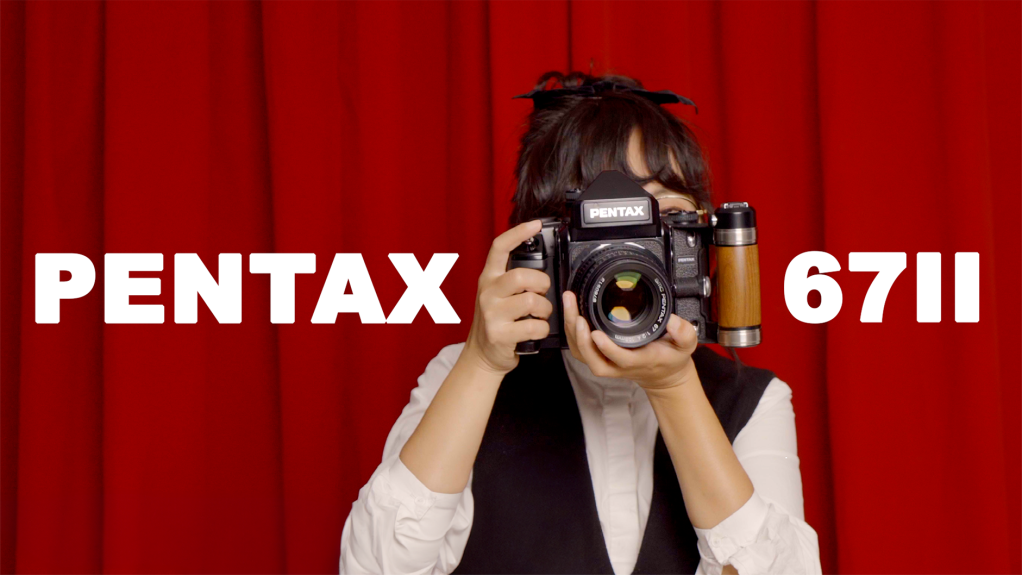
It was a cold and cloudy day. I don’t know why I always pick cloudy days to do my test shoots. I met up with my model at a park around 2 pm in the afternoon. I was shooting with my Pentax 67 with a 105mm lens. The film we were using is Kodak 5219, respooled by a Chinese lab called Alien Film.
5219 film is a 500-speed tungsten balanced film, with a color balance of 3200K. So, in theory, it should look a lot like Cinestill 800T but without the halation.

You can see from the first shot that its color tone looks much cooler, especially because we were shooting on a cloudy day. What surprised me is how smooth this film looks; as a 500-speed film, you can barely see the film grain.
The color and contrast look kinda flat, but we were shooting under very even and soft light. Another thing I would like to mention is that these films were processed and scanned by a lab in China. The film was scanned by a Noritsu 1800. I wanted to show you guys how a film lab sees the color with this film, so I didn’t do much editing with these photos.




I did increase the contrast and saturation a little; the original scan had a tiny magenta tint to it, which I corrected. But besides that, this is pretty much straight out of the lab.
These photos were shot at 500 ISO. Every time I try out a new film stock, I like to start with its box speed. However, now looking back at these photos, I don’t think this was a good “test shoot.” I like how these photos turned out, but because it’s been almost two months since I shot these, I don’t quite remember the settings. Unlike the Pentax 645Nii, the 67ii does not imprint the camera settings onto the negative, and I didn’t keep a note. Plus, I didn’t scan and convert these films myself, so I feel like I couldn’t really analyze much.
Also, it was the middle of winter, so there is very little color in the background, and we picked a full black wardrobe for this shoot. I can’t really tell how this film handles color. I do like how it renders skin tone, though; it is very similar to Cinestill 800T but even more neutral.


This one has some colors in it, the blue looks… petty blue… oh man, this is such a useless review. And look at the green, the green looks very vivid and nice too. Laugh.
Compare with Portra 400
Shooting with the 67 format is fast because there are only 10 frames per roll. So, to see the difference, I decided to shoot another roll of Portra 400. It’s daylight balanced, and many of us have shot Portra 400, so we can compare and get an idea of how much different the 5219 would look.





Portra 400, in this case, is obviously warmer since it’s daylight balanced. This roll is developed and scanned by the same lab and scanner. Just comparing the straight out of the lab, without my edit, the Portra 400 looks slightly more contrasty and slightly more saturated than the 5219.

Later, the weather got worse, so we decided to wrap it up and find somewhere indoors to shoot another roll of 35mm.
Soon, we found this huge coffee shop. I loaded up another roll of 5219 from Reflx lab. This time, we were shooting with my Canon A1, which is the only 35mm camera I brought back to China with me.





The images didn’t come out as clear and sharp as with my Canon 1V in 35mm, but we can still roughly get some ideas of how this film looks on 35mm.
The coffee shop is a better location for this test shoot, I think, because we have some different textures, a mix of window light with tungsten light, and some different colors of light sources.







Since we were indoors under pretty low light, I shot a lot of these photos close to wide open. If you watched my previous A1 review video, I talked about the 50mm 1.4 lens not being very sharp at wide open apertures. Some of these were shot at very low shutter speeds as well, so they are a bit loose and blurry.
But overall, I really enjoyed shooting this roll. Even though the photos didn’t turn out perfect, I really like the atmosphere. Shooting with such a simple camera like the A1 made this not so much a test shoot, but more like just two friends hanging out and taking some everyday photos. I realized that not everything has to be perfectly sharp and in focus all the time.












In the end, I was freaking out because the frame counter showed I had shot 42 photos and I was still able to advance. I was so terrified that I may not have loaded the film properly. But every time I advanced, it clearly felt like there was film being advanced, and when I rewound the film back up, it felt right. Anyway, it turned out I missed the very first couple of photos, which is very odd.
Once again, thanks to my model. It was super cold that day, and she was super nice and super patient with me. I had a lot of fun.
Now let’s talk about why
I waited this long to try this film, and why you should or should not shoot this film.
In theory, motion picture film is cheaper than still photography film. However, I live in the LA, there are not many labs out there that re-spool motion picture film professionally, on top of that, not many lab do ECN-2 process, even they do, they charge more than C41 film. So to me, shooting motion picture film really doesn’t cost less, if you calculate shipping and everything.
I would be saving money if I re-spool and process and all by myself, and once again, that would be a lot of work, and a lot of money upfront to buy motion picture film in bulk.
So, if you are in China, re-spooled motion picture film are much more accessible and affordable, process is also more accessible and affordable. But here in LA, not so much. If you don’t care about the cost efficiency, you just curious about how much of the differences motion picture film can make, and maybe you want to try the same film that your favorite movies were shot with, then yeah… why not. Otherwise, you have so much more choice with regular still photography films, and the price is coming down…
That being said, I brought a bunch of this film back from China with me, so I’m definitely gonna shoot more and try ECN-2 process myself as well, plus I need to scan this film myself to really understand the color little more… so I will definitely be exploring this film more down the road. And now it’s your chance to hit that subscribe button, to join me on this fun Sam learns film photography journey. And this is Sam, I will see you next time. Bye~
Camera and Film Used:
Camera: Pentax 67II / Canon A1
Film: Kodak Visition 500T / Kodak Portra 400






 Captured by Sam
Leave a comment