“Hasselblad, why!! Why do you do this to me!!”

We all know it’s never the camera’s fault; it’s always my fault. So today, I’m going to tell you what I did wrong with my Hasselblad that caused these overlapping images, so you don’t make the same mistake. Unless you think it can be an artistic choice.
Today, we’re going to continue exploring another motion picture film, the Kodak Vision 250D. This film is… zeh zeh zeh… pretty nice!

Let’s start from one day when I was casually walking around in my hometown in China. I found this really cute camera store full of insta cameras! I wanted to take a photo of the owner. He kindly said no. And then a girl walked by. She was looking at my camera and was like: is that a Hasselblad? … and then we started geeking out over the camera. She said she had never held one, so I let her take a look at mine. Then she told me she’s a photographer as well, and she has her own studio here in town… Then we exchanged contact info, and that’s how I set up another portrait test so randomly on the street.
This video is meant to be a Kodak Vision 250D portrait test. In the previous video, we tested out Kodak Vision 500T. We talked about what motion picture film is and what the differences are between motion picture film and regular still photography film. I will leave a link up there; you can go check it out later.
Let’s jump right into the photoshoot and take a look at the pictures.
Finally!! We got such a beautiful sunny day. I got to the studio about 9:30 in the morning. We only had 2 hours, so I first walked around the studio and picked out the wardrobe before the model arrived.
The studio space is on the second floor; the sunlight looks pretty nice through the window. And, after loading up a roll of 250D, I pressed the shutter somehow before I wound the film on. And this is where it all went wrong. I didn’t think it was a big deal at first; I just kept winding the film on after accidentally “taking the first shot”. Then it started to feel weird.
Every time I took a shot, the winding knob felt loose, like it wasn’t catching the film properly. And when I looked at the frame count window, sometimes it would just stop in the middle of two numbers. I then shot the whole roll without realizing this would be a problem.


After I received the scan from the lab, I was kicking myself so hard, regretting that I didn’t shoot another roll just for safety. Many of the photos turned out overlapping each other…


I really like how the color and texture turned out, though!! The skin tone looks so nice, the color is soft but vibrant at the same time, and the film grain is so fine… and the model looks beautiful… if I didn’t make the mistake, these would be good pictures!!


But oh well… Luckily, it didn’t ruin every single shot. Later, the camera seemed to catch on. I was able to crop these two shots; the framing is a bit off, but this is just what I can salvage. I did get a few shots that came out fine. Again, I really like how the color and the fine grain looks with these shots.

This is a shot I underexposed about one stop to see how the film will handle it. I think it looks pretty nice. Normally, if I underexpose the photo, the shadow would look more grainy, but this one the shadow looks pretty clean… I still prefer the slightly overexposed ones; it fits the vibe I’m going for here.


I just realized that these couple of photos have some light leak?? Not sure what happened there. Might be from me winding the film wrong, or might be the sealing of the film, or it might be developing.
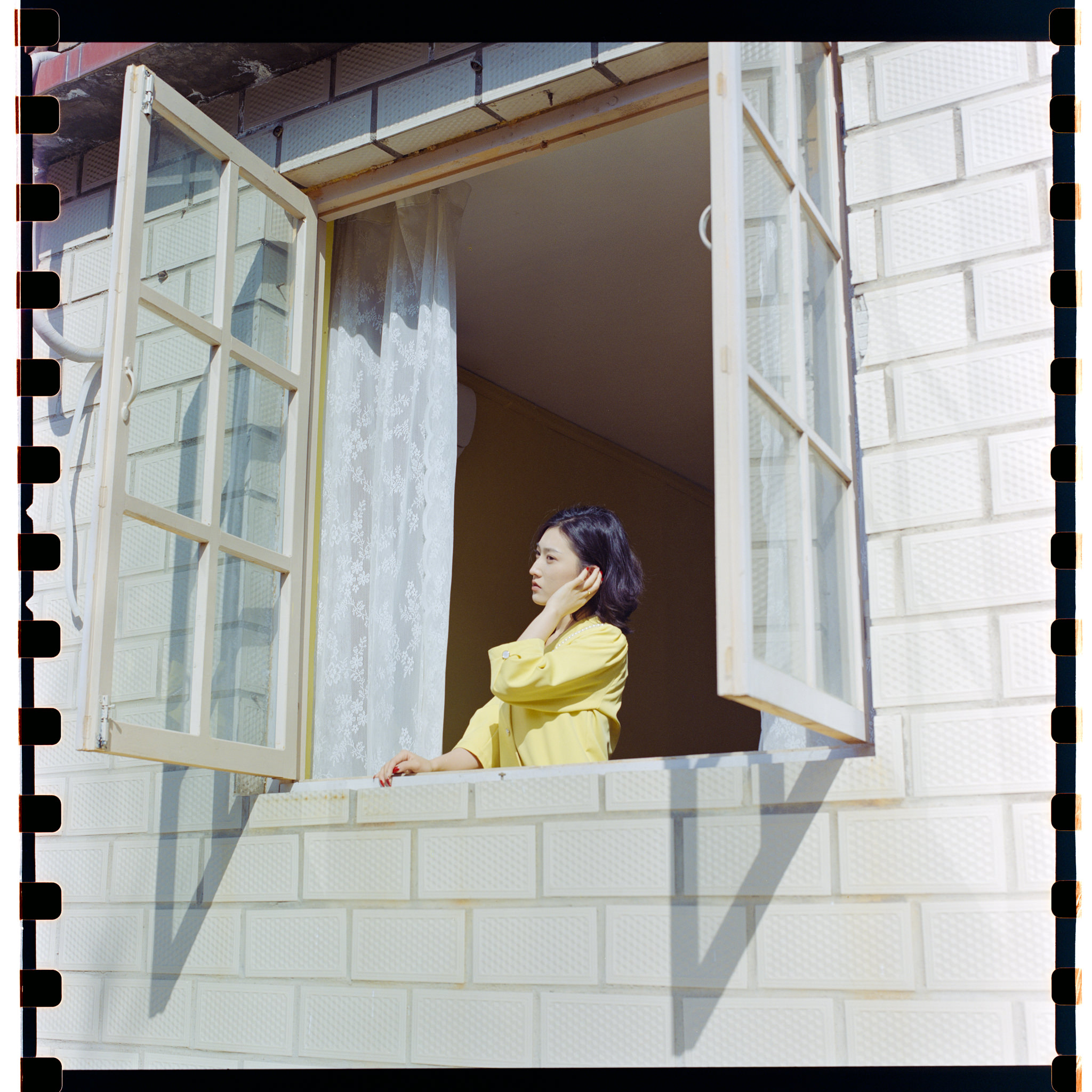

For the last two shots, I stepped outside and had the model stand in direct sunlight. The contrast looks really nice. I would have thought the light ratio between the outside and the inside would be too big, but you can see the transition is very smooth.

Since I didn’t wind the film right, the last frame got cut into, so I have to crop it in once again. Thanks to the 6×6 negative, after cropping, there are still quite a lot of pixels. I should have framed out the air conditioner, though; it’s distracting.
Out of 12 frames, I salvaged 9 shots. I guess that’s not too bad. After this roll, I wanted to shoot another roll with my Pentax 67 in another room, and yes, you guessed it, I didn’t bring a tripod. The 250 speed just won’t be enough anymore. So I decided to shoot a roll of Portra 800. I think this is my first roll of Portra 800, like ever?

I took the first shot while she was removing her earrings… wait a minute, is this Portra 800? This looks very clean for an 800 speed film. I imagined 800 would look much more grainy than this. This roll was shot with the 105mm f2.4 lens; the focal length is very close to the 80mm on the Hasselblad.




Even with 800 speed film during the day, in a room that has no window facing the sun, I shot a lot of these at f2.8 or f4 open if I remember correctly. This roll turned out surprisingly smooth… granted, I never shot Portra 800 with a medium format camera before, the clean and smooth look might be the film itself, might be the Pentax 67, or it might be the scanner.
Now I’m wondering, this fine and smooth look from the 250D might also be because of the scanner. All of these photos I’m showing you in this video were processed by a lab in China, and for the first time, I had the opportunity to have them scan these films with an Imacon scanner. If you don’t know what Imacon is, it’s probably the best film scanner there is, and it is a really, really expensive scanner.




Now I’m starting to think these photos look the way they are might be the scanner’s doing… because look at this, I know Portra is professional-grade film, but I really expected 800 speed film to look grainier than this… I don’t know. I might have to scan these films with my own scanner again to see the difference. It’s really hard to judge and compare now since the post-process has changed.

For the last shot, we went back to the first room we shot at. I wanted to see the difference, but I mean, at this point, there is nothing we can really compare, different camera, different film. But as you can see, on the 250D shot, there are these perforation holes on the two sides, so technically, the motion picture film is slightly smaller than the regular still photography film. And I’m not a fan of these holes; just for demonstration purposes, I left all the photos uncropped in this video.
10 shots went by really fast; sometimes I hate how little the Pentax 67 can shoot per roll, sometimes I’m glad one roll only has 10 shots. I set up this photoshoot to test 250D, and we unexpectedly had a nice and sunny day in the middle of winter. I had to shoot another roll outside.
So I loaded up another roll of 250D.

I really, really like how the color turned out. It’s so neutral and soft, pretty low contrast and low saturation. At this point, it was almost noon. This could be the worst time to take portraits outdoors, since it’s winter, the sun wasn’t very harsh even at noon, and the film just handles the high light and shadow so nicely. I did lose some details here in the hair, but the falloff still feels very smooth.

I think these photos are all about at least 1 stop overexposed. This is how I would normally expose for portraits. The scans the lab sent me are even more desaturated and flat. I did increase the saturation and contrast, but overall, I kind of like this flat look.

In this shot, there is so much cyan and green in the background; the skin tone came out a bit off. I have to edit the skin tone specifically for this one. But besides this, all of the photos are pretty simply edited by adding saturation and contrast.
We were shooting in front of this vintage-looking hair salon; the owner very kindly let us take one shot inside her salon.





I really think these photos turned out better than I expected them to be. I really liked how the color looks and the fine grain with this film. I wanted to say the 250D is definitely worth trying out, if I can’t say this is one of my favorite films yet.


In the 2 hours of time, we quickly shot 3 rolls. However, I think because these films are scanned with a new scanner that I never tried before, it’s really hard for me to judge the color and the texture of this film. I might have to rescan and reconvert them in my own post-process to really understand the potential of this film. I might have to shoot more with this film and maybe compare this with another one of my favorite films, the Gold 200, since they’re both 200 speed… to say how good this film really is.
So stay tuned; there will be a part 3 of “Sam exploring Kodak motion picture film”. I know this video might not be very helpful, but I will try to shoot with this film more and to learn more about it. So please consider subscribing to my channel; leave me a comment down below if you have tried this film or are thinking about trying it… And this is Sam, I will see you next time.







 Captured by Sam
Leave a comment